Checkout my recent review of BuildEdge Plan 2.0 plugin for SketchUp
CADdigest.com.
Tuesday, December 03, 2013

Tuesday, May 14, 2013
Thoughts on the Smart Geometry 2013 Symposium
 Smart Geometry 2013 ended last night (04.21.13) with a rather chilly cookout at the University of London Portico Building. I find it funny that an American has to travel 3400 miles across the Atlantic to get a burger and hotdog, it was a long way to attend another Smart Geometry conference but worth it.
The Smart Geometry 2013 conference was at the Bartlett School of Architecture at the University College of London (www.bartlett.ucl.ac.uk), in London, England. It had been 35 years since I was last in London and I wish to thank Bentley for making it possible. Though the Bartlett School of Architecture opened in 1841 this was the first time they have hosted a Smart Geometry event. The theme of Smart Geometry 2013 was – Constructing for Uncertainty. Smart Geometry has two parts:
1. The four day workshop made up of 10 clusters open to 100 hand selected applicants who work for four intense days exploring the cluster topic
2. The two day conference consisting of the day one Talkshop and the day two Symposium featuring keynotes from a variety of speakers dealing with the conference theme.
Three of the four main symposium speakers addressed issues that I found relevant to today's practice of Architecture and Engineering.
I enjoyed Tristram Carfrae of Arup, symposium keynote. The world renowned bridge engineer brought a bit of common sense and real world experience to Smart Geometry which it needs from time to time. Tristram discussed some unusual design considerations on bridges that he designed and built. It was his final point that I found most interesting - That a Digital Divide exists, not between generations, but between the upper and lower ends of our organizations and professions. Like me he feels this is the AEC world’s greatest problem. Alas, he could offer no solutions. Follow up discussions with other symposium attendees convinced me he raised an unspoken but growing concern. Not the usual smart geometry question, it is a question that a future smart geometry cluster might find challenging.
The second Keynote of the Symposium was Michelle Addington’s presentation – Data and it’s Dis-contents. Michelle’s talk focused on the belief in “false” information so prevalent in our world today. The beginning of her talk was the most telling. She brings up when politicians, diplomats, and government officials gather to discuss climate change, buildings and energy usage, they don’t invite or talk to architects and engineers. Why involve professionals who understand the subjects? Instead they find a single “expert” or “study” select the specific piece of information that supports their position and run with it. Regardless of the specific information’s validity or accuracy. Funny thing is, solutions that come from these gathering seldom work. Gives them an issue to run on next time, but it should be a wakeup call for architects and engineers to get involved.
The symposium’s third speaker was Ben Cerveny, who addressed another of my core “problems/issues”. The issue of - Who decides on how things (in the built environment) work? The core point being - Should the architecture and engineering professions allow others to make decisions that affect how they operate? Should professionals make these hard decisions themselves? I’m a proponent of the latter but the reality is favoring the former. Will AEC professionals make these important and profession changing decisions or will Google? Smart Geometry 2013 didn't have the answers but the symposium’s speakers were asking the hard questions. I hope the AEC industry hasn’t waited to long to answer.
Tuesday, May 07, 2013
Xi Mtower PCIe Review
Checkout my recent review of the Xi MTower PCIe Stryker workstation over at CADdigest.com.
While you are over at CADdigest.com you can also check out my two part review of Synergis Adept EDMS part 1 and part 2.
While you are over at CADdigest.com you can also check out my two part review of Synergis Adept EDMS part 1 and part 2.
Saturday, November 24, 2012
Everyone was a Winner at the 2012 Be Inspired Awards
Last week (November 12-15, 2012) I was lucky enough to attend the 2012 Be Inspired Awards held at the Grand Hotel Krasnapolsky in Amsterdam as a member of the press for TenLinks.com (www.tenlinks.com). According to the official conference program;
Bentley’s annual Be Inspired Awards program is the only competition of its kind that is global in scope and comprehensive in the categories covered, encompassing all types of infrastructure projects. Its goal is twofold: to advance innovation and best practices in design, engineering, construction, operations, and project delivery; and to promote the extraordinary work of organizations that help sustain the world’s infrastructure.
The competition is open to all users of Bentley software, and the winners are selected by independent panels of jurors comprising industry experts.
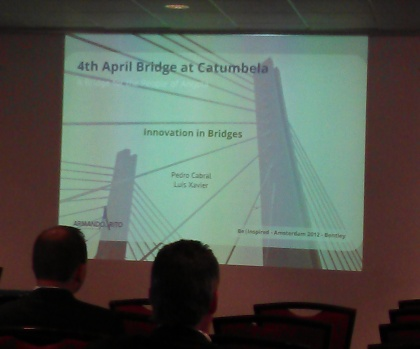
While only one winner in each of the 20 categories went home with a trophy each of the 60 firms/projects participating in the competition this year are winners in their own right. As a colleague said as we were leaving – “…what he likes about the Be Inspired is it shows that humans can still create great things...” which is something we tend to forget in today’s chaotic world.
The list of all the 2012 Be Inspired award winners, along with the other finalists and a brief description of the projects can be viewed at:
If you want to get a feel for what people were thinking during the conference head on over to Twitter and do a search on the conference hash tag #BeIn2012. If you look around a bit you might even see some of my witty comments (tweets).
Two of which come to mind;

Rande Robinson @randerobinson
The Swedish transportation admin was BIM before BIM was cool #bein2012 though I doubt they put peanuts in their coke...
This tweet intrigues me because it is the first time I have ever heard an organization actually explain what BIM means to them and what they expect it to look like in a project deliverable. I can’t wait to re-watch the video of the presentation when it becomes available.
Rande Robinson @randerobinson
Common theme in the projects I've seen so far at #bein2012 Bentley software speeds them up...compresses the traditional project time frame
This tweet was about the common theme that using/ applying Bentley software allow all of the projects to be finished on time and within very tight schedules. Presenters were adamant these projects would have been impossible without it. This one simple statement kept popping up in every presentation I attended. The question I had and still have about this is simply. Does technology speed things up or does a shorter time frame force people to refine and reassess the way they do business? It is something we need to think about.
That’s it for now in my next blog post I’ll take a look at some of the interesting things that came up at press briefing on the first day of the conference. So stay tuned.
Note: Bentley Systems graciously covered expenses and registration for the event but did not in any way influence the content of this post the information and opinions presented are my own.
Sunday, October 14, 2012
New tablet
Can you blog from a 7 inch tablet? Yes as long as you don't have to type to much. Or maybe if you are a two thumb typist. Which I'm sure if you follow any of my tweets, you already know I'm not. I will say it is easier than on a phone. So stay tuned to see what else I figure out about my new nexus 7 tablet.
Thursday, March 29, 2012
Smart Geometry 2012 – part 1 an overview
 |
| press row |
Started this post several days ago sitting in the Albany, NY airport waiting for my flight home from the 2012 SmartGeometry Conference (SG2012). I was attending the conference for the first time as a member of the “Computer/CADD press” thanks to an opportunity afforded to me by Roopinder Tara and TenLinks.com. Now I’m sitting in a hotel room in Raleigh, NC trying to finish it. Not only did I get a chance to attend a conference that I had be keeping tabs on for the past several years, but I also got to meet and talk to people whose articles I have been reading first in print and now on the web for the past 20 some years (as the commercial says “priceless”).
Though having followed past Smart Geometry conferences via the web and twitter I wasn’t really sure what to expect at an “architectural computer design” conference. After having spent 2 ½ days sitting, listening, watching and even asking a few questions, I still really can’t describe it. The best description that I can come up with is that “Smart Geometry is an ongoing Community located at the Intersection of Design, Technology and the Arts.” If you want to dive into it in more detail just check the Smart Geometry website at http://smartgeometry.org.
 |
| EMPAC center |
SG2012 was held this year on the campus of Rensselaer Polytechnic Institute (RPI) in Troy, NY at the Experimental Media and Performing Arts Center (EMPAC) which itself is an interesting blend of architecture, engineering and the arts. The conference is broken into three parts –Workshops (or clusters) , Talkshop and the Symposium. The workshops are four continuous day of interaction and work for the hand selected group of participants in each of 11 specific clusters. This year’s overall conference topic was MATERIAL INTENSITIES.
 |
| cluster description |
The 10 clusters were:
- Micro Synergetics
- Composite Territories
- Bioresponsive Building Envelopes
- Material Conflicts
- Gridshell Digital Tectonics
- Beyond Mechanics
- Reactive Acoustic Environments
- Transgranular Perspiration
- Form Follows Flow
- Ceramics 2.0
- Kids Cluster: Building Manhattan
While I didn't get to participate in any of the clusters (to tell you the truth, I’m not sure I could have contributed much if I had) I did get to visit each cluster in the work areas set up in the EMPAC and talk to the participants about their work. While most of them were tired from a week of continuous activity they all were excited about the projects they were working on and the chance to be part of the SG2012. If you think about it one can’t ask for much more than that from a conference.
While I found all of the sessions very interesting, it was the last one - Material Flows and Practice that seemed to stir things up the most. This was thanks to a presentation by Zoe Coombes and the discussion that followed (not to mention a picture of a pigs head on a Coombes designed butcher block displayed during her presentation). One thing I found interesting was the number of architects who make a living designing things other than houses and buildings. Who would of thought that architects design things like lamps, furniture and even butcher blocks?
The Symposium format was a traditional conference setting where a series of speakers gave presentations under the general topics of:
While all the speakers gave what I considered interesting talks, the two stand out presentations were given by Enric Ruiz-Geli, an architect and visual artist, whose firm Cloud 9 has created some amazing buildings. Ruiz-Geli talked about a “Focus on Reality” and attacking the problems that plague the world. The second presentation was by Perry Hall, a visual artist and musician,, who creates amazing images from mundane things. Perry talked about “Painting Far from Equilibrium” which was, for me, the most thought provoking presentation of the conference. All the presentations, round table discussions, and cluster videos will eventually be posted to SmartGeometry Website. Check it out over the course of the next few months as they get the information posted.
That’s my quick overview of SmartGeometry 2012. In my next post, I’ll look at what set the world a “twitter” during #sg2012.
We (the press) attended the more traditional TalkShop and Symposium parts of the conference. The Talkshop (Friday) was a series of four 90 minute round table discussions
 |
| Material Flows and Practice Round Table |
(they actually had round tables) on the following topics:
- Shifting Attitudes
- Energy, Environments and Conflicts
- Matter of Scale
- Material Flows and Practice
The Symposium format was a traditional conference setting where a series of speakers gave presentations under the general topics of:
- Particle Architecture
- Material Science
- Engineering Material
- Intensities in Art
- Generating Material
That’s my quick overview of SmartGeometry 2012. In my next post, I’ll look at what set the world a “twitter” during #sg2012.
Subscribe to:
Posts (Atom)


